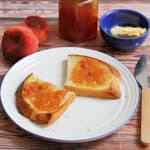
Easy Peach Jam
A simple flat peach jam recipe made with ripe peaches, sugar, and lemon juice. Perfect for preserving the taste of summer.
Servings 60 tbsp
Calories 34kcal
Ingredients
- 680 g flat peaches
- 456 g caster sugar
- 2 tbsp lemon juice fresh
Instructions
- Wash your flat peaches, then cut them into pieces, cutting out the stones. Leave the skin on.680 g flat peaches
- Put the peach pieces into a large saucepan with caster sugar and lemon juice. Heat gently, stirring occasionally to help the sugar dissolve.456 g caster sugar, 2 tbsp lemon juice
- Once the solution is clear with no undissolved sugar in the bottom of the pan, and smooth without any crystals you can move onto the next step.
- Turn the heat up and bring the pan to a rolling boil. See the photo to see what this looks like. Keep it at a rolling boil for 5-10 minutes then use a food thermometer to check if the jam has reached 105°C (jam setting point).
- Once your jam has reached 105°C / 221°F and you have done a wrinkle test (take the jam off the heat, drop a teaspoon of jam onto a pre-frozen small plate, leave for 2 minutes to cool and check that when you push it with a finger it wrinkles) you can be sure it has reached a high enough temperature to properly set. If it does not reach the temperature and/or fails the wrinkle test, put the pan back on the heat and retest after a few minutes.
- Pour the hot jam from the pan into hot sterilised jars. It is useful to use a jam funnel to stop it spilling. Seal with the jam jar lids. The jam will set as it cools. As the jam cools it will contract and create a natural vacuum seal. Store the jars in a cool dark place.
Notes
Yield
3 jars (280 ml each).
Adjusting the recipe
Weigh your flat peaches after removing the stones and use 80% of their weight as the weight of your sugar. Keep an eye on the amount of lemon juice too, you may need to reduce or increase it accordingly depending on the weight of peaches you are using!
Storage
Store unopened jar in a cool dark place. it will keep for 1-2 years.
Once opened, keep the jam in the fridge, use a clean spoon to serve it and use within 2-3 months for best flavour and quality.
Removing Scum
If scum forms on your jam as it boils, you can remove it by adding a small amount (half a teaspoon) of butter to the jam at the end, while it is still hot. The scum is just trapped air bubbles. The butter release surface tension so the bubbles disappear.
If you prefer not to use butter then vegetable oil can used instead or you can skim the foam off with a cold metal slotted spoon.
Jarring Up
Before starting the jam preparation, make sure you have washed your jars in very hot soapy water or passed them through your dishwasher.
Once washed (by hand or in the dishwasher), rinse the jars and lids well then put them on a baking tray in a low oven (approx. 140°C) until dry.
The resulting steam sterilises your jars and lids and make sure they are ready for filling with jam.
Pouring the hot jam into jars can be tricky if your saucepan is really heavy and you need to use your other hand to keep your jars still.
I like to use a jam funnel which stops the jam making a mess everywhere as you pour it, a wide funnel is easy to pour into from the saucepan and funnels the jam into your jars, reducing the clean-up needed afterwards.
Once your hot jam is in the jars, put on the lids tightly and leave to cool.
Troubleshooting
Sometimes, despite best efforts, jam doesn't set or it sets too firm. Here are my tips to fix that.
My jam did not set
This could mean you undercooked the jam (it didn't reach the setting point) or you did the wrinkle test when the jam was still too warm, or there was too much liquid, too little pectin or acid.
Sometimes jam takes a while to set in the jar so make sure you are not testing too soon too. Leave it for 2 days.
If your jam is still not set, put it in a pan with a little extra lemon juice (one to two tablespoons) and bring it to a rapid boil for 2-3 minutes. Remove the jam from the heat. Retest a spoonful on a frozen plate with the wrinkle test, make sure the jam on the plate is completely cool before testing it. Pour the hot jam into clean, re-sterilised jars.
My jam is set too hard
This might happen if you overcook it or use too much pectin (if you were making a jam with added pectin, unlike this recipe).
To correct this, put the jam back in a pan, add a little water (start with 50 ml) and heat it gently to melt or dissolve the jam. Don't reboil. Repeat the wrinkle test (make sure the jam is completely cool on the plate). Put the hot jam in freshly sterilised jars.
A Note on the Traditional UK Method
This recipe uses a traditional UK "hot fill" method rather than US water-bath canning. Because peach jam is highly acidic and this recipe features a high sugar-to-fruit ratio, the sugar acts as a natural preservative by binding moisture and preventing bacterial growth.
Pouring the boiling hot jam directly into oven-sterilised jars creates a natural vacuum seal as it cools. This eliminates the risk of spoilage and botulism, making post-bottling water boiling, often used in the USA, completely unnecessary for safety.
In the UK, to be called jam, a product must contain at least 60% sugar. If not it cannot legally be called jam but must be called a preserve or fruit spread. You'll see that this recipe contains 80% sugar so meets the requirement and represents a traditional jam recipe.
Nutrition
Serving: 1tbsp | Calories: 34kcal | Carbohydrates: 9g | Protein: 0.1g | Fat: 0.1g | Saturated Fat: 0.002g | Polyunsaturated Fat: 0.01g | Monounsaturated Fat: 0.01g | Sodium: 2mg | Potassium: 15mg | Fiber: 0.2g | Sugar: 9g | Vitamin A: 37IU | Vitamin C: 1mg | Calcium: 1mg | Iron: 0.04mg